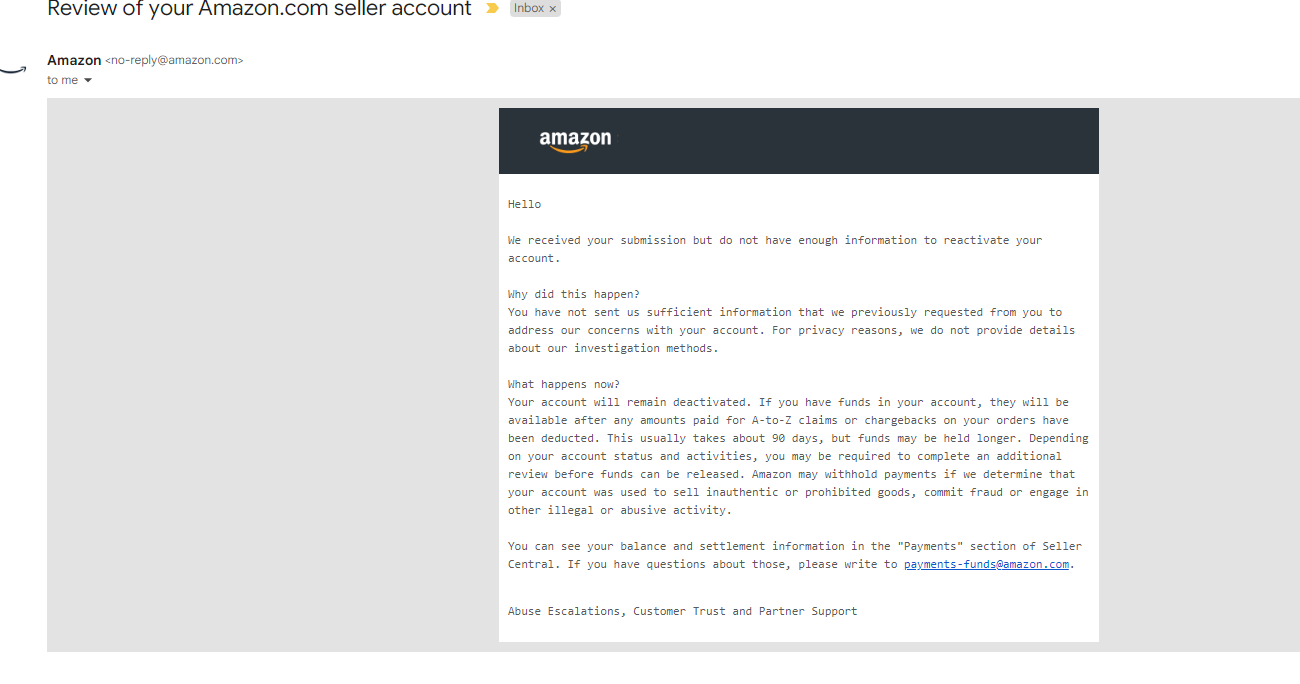
Amazon Account Reinstatement (2025): Definitive Appeal & POA Guide
Suspended Amazon account? Whether your deactivation is recent or a decade old, the path back is a precise Plan of Action (POA), solid evidence, and smart escalation. This guide gives you a copy-paste POA, metric thresholds, Section 3 tactics, old-account revival strategy, and geo-specific FAQs.
- Diagnose first: tie the violation to documents you can prove (invoices, LOAs, logs, photos).
- POA = 3 parts: root cause → corrective actions (past tense) → preventative systems (owners, cadence).
- Documents: verifiable suppliers; invoices ≤365 days (authenticity); ASIN/SKU mapping.
- Escalate thoughtfully: only after substantive revision; never resend the same POA.
- Old accounts win: emphasize maturity, new controls, and present compliance capacity.
What an Amazon suspension means
A seller suspension halts listings, disbursements, and some account tools until you prove compliance. Causes fall into three buckets: performance (ODR/LSR/VTR), policy (e.g., restricted items, review manipulation), and conduct (Section 3/related accounts). Reinstatement hinges on a clear, evidence-backed POA.
How to read your suspension notice
- Reason cited: the exact policy/metric (e.g., “ODR exceeded 1%,” “inauthentic complaints”).
- ASINs: for listing actions, note each ASIN to map proof (invoices, LOAs, photos).
- Required actions: almost always a POA; sometimes removal orders or catalog fixes.
- Evidence requested: invoices (dated, itemized), LOAs, communication logs, images.
Appeal process: step-by-step
- Study the notice; restate the exact reason in your draft.
- Run a root-cause analysis (why the issue occurred—process/gap/tooling).
- Collect proof (verifiable invoices ≤365 days; LOAs; photos; audit logs).
- Draft your 3-part POA (root cause → corrective → preventative).
- Submit via Account Health → Appeal/Submit new information.
- Monitor case log; respond quickly to clarifications.
Copy-paste POA template (works for performance, IP, restricted, Section 3)
Subject: Appeal for Account Reinstatement – [Seller ID / Store Name]
1) Root Cause
• Our account was deactivated for [reason from Amazon notice, e.g., “inauthentic complaints on ASINs …”].
• Root cause: [e.g., supplier vetting did not verify manufacturer authorization for Brand X; invoices lacked full
contact fields; packaging variance on lots delivered 03/2025.]
2) Corrective Actions (Completed)
• Customers: Issued refunds/replacements for affected orders [IDs/timeframe]; opened direct support channel.
• Inventory: Suppressed affected ASINs; initiated FBA removal [ID]; quarantined non-conforming stock.
• Documents: Replaced supplier with authorized source; attached invoices (dated, itemized, traceable), LOAs, and
supplier contact; aligned product detail pages to actual packaging/specs.
• Training: Targeted retraining for ops/support on authenticity, condition, and listing accuracy.
3) Preventative Measures (Ongoing)
• Supplier Vetting: New KYC (business registry, brand authorization, invoice validation, sample checks).
• Doc Controls: Invoices mapped to ASIN/SKU; 24-month retention; quarterly audit by compliance lead.
• QA & Listings: 2-step listing review; packaging variance checks; periodic test buys.
• Performance Guardrails: ODR ≤1%; LSR ≤4%; VTR ≥95%; alerts via [tool]; weekly review by [role].
• Governance: Compliance owner [name/role]; escalates issues within 24h; quarterly compliance report.
We understand Amazon’s policies and are committed to sustained compliance. Please review the attached documents
(invoices/LOAs/audit logs/photos) and consider reinstating our selling privileges.
Sincerely,
[Name, Title] • [Email] • [Phone]
Old account reinstatement strategy (even years later)
Amazon does grant second chances—especially when you demonstrate growth and present-day controls. If the account data is gone, reconstruct facts from old email receipts, bank statements, shipment logs, and supplier confirmations. In your POA, highlight maturity since the original incident and today’s preventative systems.
Section 3 & related-accounts: handling severe actions
- Disclose & explain: be explicit about shared resources (IP, addresses, devices) and how you isolated operations.
- Controls: separate entities, finance, devices, networks; written SOPs and logs.
- Evidence: corporate docs, leases, IP assignments, payroll, network diagrams, device IDs.
- Never open a new account: it compounds the violation and reduces reinstatement odds.
Inauthentic, IP, and “Used Sold As New” (USAN)
Inauthentic/Counterfeit
- Invoices: dated ≤365 days; supplier name, address, phone; itemized with model/SKU; quantities match.
- LOA or brand authorization when required; supplier verification contact.
- Photos: packaging labels, lot codes; show your warehouse process.
IP (Trademark/Copyright/Patent)
- Respond to the specific claim type; include license/authorization or design/utility opinion if relevant.
- Fix listings that imply unauthorized branding; remove infringing media.
- Document takedowns and catalog corrections with timestamps.
USAN (Used Sold As New)
- Tighten inbound QC; sealed retail packaging checks; tamper seals; lot tracking.
- Detail page alignment: exact condition, model, and accessories.
- Proactive replacements and refunds; include evidence in the POA.
Performance metric thresholds (typical targets)
- Order Defect Rate (ODR): ≤ 1%
- Late Shipment Rate (LSR): ≤ 4%
- Pre-fulfillment Cancellation Rate: ≤ 2.5%
- Valid Tracking Rate (VTR): ≥ 95% (category dependent)
Use alerts and dashboards; review weekly; keep written playbooks for exceptions (carrier failures, spikes, recalls).
Escalation ladder & case-log best practices
When to escalate
- After a substantive rewrite that addresses feedback (not a resend).
- When you add stronger documentation (new invoices/LOAs/photos/logs).
- When the case stalls for an extended period without movement.
How to escalate
- Reference prior case IDs and list what changed in this submission.
- Label files clearly (e.g., Invoice-BrandX-Apr-2025.pdf); keep attachments lean and legible.
- Maintain a calm, professional tone; demonstrate controls, not frustration.
Why attorney-supervised appeals outperform generic templates
| DIY Template | Attorney-Supervised (AMZ Sellers Attorney®) | |
|---|---|---|
| Root-cause accuracy | Often generic | Fact-specific, evidence-mapped |
| Invoice/LOA readiness | Misses Amazon criteria | Verified, supplier-traceable |
| Preventative systems | Vague promises | Auditable SOPs, owners, SLAs |
| Escalation | Repeated resubmits | Strategic, substantive revisions |
Common mistakes to avoid
- Skipping the real root cause; only describing symptoms.
- Submitting a generic POA or blaming Amazon/customers.
- Missing or invalid documentation; unreadable scans.
- Opening a new seller account while suspended.
- Resending the same POA after a denial.
Frequently asked questions
How long do appeals take?
Anywhere from a few days to several weeks depending on complexity and queues. Respond to any follow-ups quickly.
Can I talk to someone at Amazon?
Use Account Health for written appeals. Account Health Support may call on some issues, but Seller Performance communicates primarily in writing.
What if my appeal is denied?
Rewrite it substantially. Address gaps, add required evidence, and improve preventative systems before resubmitting or escalating.
Need a winning POA—fast?
Get an attorney-supervised appeal tailored to your notice, documents, and listings—plus a stepwise escalation plan.
Free Consultation →
RSS Feed